




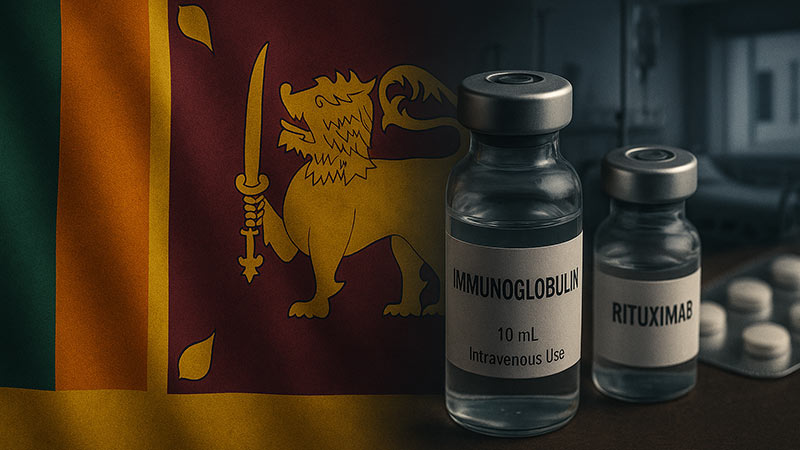
Against the backdrop of the contentious trial concerning the procurement of substandard Human Immunoglobulin and Rituximab being heard before the Permanent High Court Trial-at-Bar in Colombo, the extensive dock statement delivered by former Minister of Health Keheliya Rambukwella—cited as the eighth accused—has ignited widespread scrutiny across the country’s legal spheres and media landscape.
Moving well beyond political rhetoric and sensationalized headlines, Rambukwella presented a rigorous, chronological sequence of events supported by verifiable documentary evidence—ranging from official Treasury directives and technical inventory assessments to passport immigration stamps and telecommunication tower data—that fundamentally challenges the prevailing public narrative.
A veteran parliamentarian with nearly three decades of public service across nine ministerial portfolios, who previously served as the official Defense Affairs Spokesperson during the height of the civil war and survived three attempts on his life, Rambukwella opened his statement with a pointed question: why would a public representative whose residential address and contact details have always remained openly accessible to the public conspire in a clandestine procurement racket?
The origin of the case dates back to the severe economic and institutional collapse Sri Lanka endured in 2022. With the island relying on imports for roughly 80% of its pharmaceutical supplies, national foreign exchange reserves had plunged to a critical $35 million, leaving the Treasury unable to settle payments even for offshore fuel tankers. Taking charge of the Ministry of Health at dawn following an urgent appeal from the President, Rambukwella maintained that his sole mandate was preventing the catastrophic collapse of the public healthcare sector and averting medicine queues that would have cost countless civilian lives.
Addressing the heavily scrutinized Cabinet papers, Rambukwella produced records establishing that the policy paper governing the Emergency Health Sector Procurement Guidelines was submitted not by him, but by the then-Prime Minister and Minister of Finance, Ranil Wickremesinghe.
As Health Minister, Rambukwella had merely tendered a memorandum dated May 30, 2022, requesting the continuation of the existing COVID-19 emergency procurement protocols. That request was turned down; instead, the Cabinet of Ministers adopted a revised emergency procurement framework formulated and introduced through observations submitted directly by the Finance Minister.
Similarly, the subsequent Cabinet paper presented on September 26, 2022, regarding the reallocation of funds under the $200 million Indian Credit Line, was an official procedural step initiated at the Treasury’s direct behest. Official letters marked ‘P-65’ and ‘P-66’ issued by the Deputy Secretary to the Treasury had formally warned of significant operational delays by the State Pharmaceuticals Corporation (SPC) in utilizing the allocated credit line.
To prevent the total lapse of these essential funds before year-end, the Ministry of Finance instructed that unutilized allocations be reallocated to private suppliers, requiring mandatory Cabinet ratification under standard administrative guidelines.
Crucially, Rambukwella emphasized that this Cabinet memorandum sought no approval for any specific drug, commercial formulation, or preferred supplier. Annexed to the paper was an official stock summary certified and submitted by the technical head on the ground: Dr. Chandana Wijesinghe, Acting Director of the Medical Supplies Division (MSD).
Rebutting the charge that he engineered an artificial medicine shortage, Rambukwella reminded the court that an executive minister does not personally inspect warehouse shelves; policy decisions must rely on official assessments furnished by qualified technocrats. Furthermore, the legal and administrative onus of implementing Cabinet decisions rests exclusively with the Ministry Secretary and designated procurement committees, processes in which the Minister held no operational involvement.
Perhaps the most startling revelation in the dock statement exposed grave discrepancies in the documentary record regarding ministerial meetings. The exhibit marked before the court as ’10-V-63′ claimed that a key meeting regarding these procurements was held at the Health Ministry under Rambukwella’s personal chairmanship on September 5, 2022.
However, official records from the Department of Immigration and Emigration and the corresponding entry and exit stamps on his passport conclusively prove that he was not in Sri Lanka at the time, having traveled to Bhutan between September 2 and 7 to attend the 75th Session of the WHO Regional Committee for South-East Asia.
Likewise, regarding document ’10-V-53’—which recorded another crucial procurement meeting supposedly convened under his chairmanship at 10:00 AM on October 10, 2022—court-tendered Dialog telecommunication tower data confirmed that the Minister was in Ja-Ela alongside the President attending a public state function throughout that entire morning. “At whose behest were these meeting minutes concocted?” Rambukwella questioned, highlighting how official files were drafted using his name while he was physically absent.
The former Minister also highlighted that the entire criminal investigation had originally been initiated by his own office. Upon receiving credible intelligence that unauthorized operators were supplying products under forged documentation—having secretly bottled liquids at an unlicensed domestic site rather than importing genuine batches from India—Rambukwella instructed his advisor, Sanjaya Rajeev Gerard Perera, to lodge a comprehensive written complaint with the Criminal Investigation Department (CID). It was this ministerial complaint that initially brought the fraud before the Maligakanda Magistrate’s Court.
Rambukwella pointed out the stark irony of the resulting outcome: the very Cabinet Minister who took the unprecedented step of referring internal ministerial wrongdoing to the CID was subsequently branded a co-conspirator and subjected to over eight months of detention. “If this is the treatment meted out to a complainant, will any minister in the future dare to report corruption within their ministry to the CID?” he asked, warning of the chilling precedent this sets for state governance.
The statement further brought to light the grueling conditions under which his CID statements were recorded on December 26, 2023, and February 2, 2024. Despite never being informed that he was considered a suspect, the 72-year-old was interrogated continuously for 11 hours—from 9:00 AM to 8:00 PM. Suffering from documented clinical conditions including diabetes, severe gastritis, and stress-related memory lapses, he was denied timely medication and meals until the lengthy inquiry concluded.
Throughout the process, he was confronted with technical administrative files generated by subordinate staff in 2022, yet steadfastly maintained that he possessed no connection to the illicit domestic bottling or the forgery of import papers.
While public accountability demands that the counterfeit drug syndicate face the full rigor of the law, Rambukwella’s dock statement exposes a troubling disconnect: the transformation of a policymaker—who acted strictly on Treasury directives, relied on official MSD documentation, and formally sounded the alarm to law enforcement—into a primary defendant, while technical and operational perpetrators remain insulated.
Concluding his statement, Rambukwella affirmed that his enduring trust in the independent judiciary had sustained his family through three years of public adversity, expressing firm confidence that an impartial evaluation of the objective evidence will dismantle politically driven assumptions and establish the truth.