




Sub-headline: Beneath the warm optics of agricultural cooperation in Madawachchiya lies a quiet, high-stakes geopolitical tug-of-war over Sri Lanka’s ancient heartland and northern gateway.
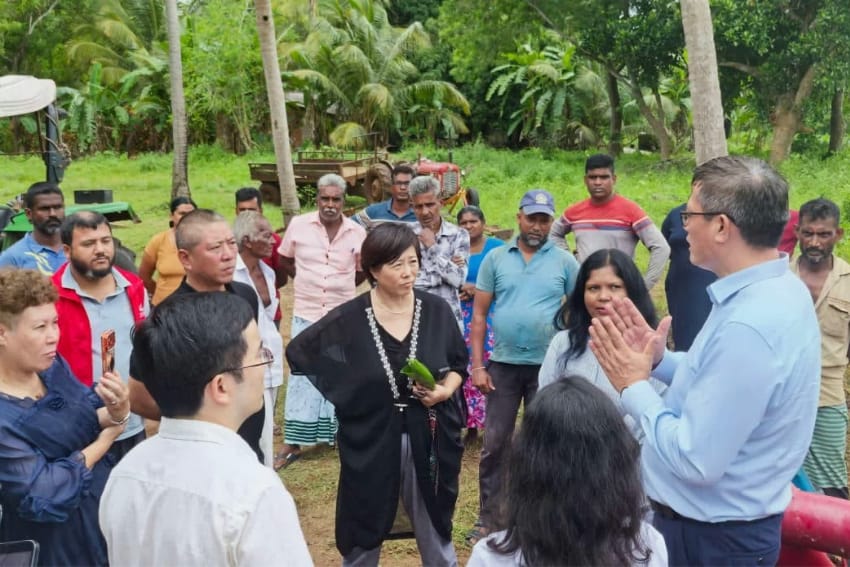
In the sun-drenched paddy fields of Madawachchiya, a rural farming town in Sri Lanka’s North Central Province, a striking diplomatic scene unfolded on November 14. China’s newly appointed Ambassador to Sri Lanka, Wei Huaxiang, knelt beside local cultivators to inspect growing rice stalks, sitting with villagers to listen to their day-to-day agricultural struggles.
Hours later, the Chinese Embassy’s official social media channels broadcast the moment under an unmistakable banner: “From the Paddy Fields to Farmers’ Hearts!”—complete with hashtags celebrating #GrassrootsDiplomacy and #FoodSecurity.
On the surface, it was a classic tale of rural goodwill. Yet for seasoned observers of Indian Ocean geopolitics, the timing and location of Ambassador Wei’s outreach were anything but coincidental. Just weeks earlier, the ancient city of Anuradhapura had found itself at the center of an intense domestic political drama; one involving a massive Rs. 7.7 billion developmental grant from New Delhi.
The Sacred City Controversy
In early October, the Sri Lankan government unveiled plans to revitalize the Anuradhapura Sacred City with Rs. 7.7 billion in financial assistance from the Government of India. Designed to modernize access roads, upgrade devotee facilities, overhaul waste management, and protect archaeological monuments, the project was meant to stand as a flagship symbol of shared Indo-Sri Lankan Buddhist heritage.
Instead, it quickly ran into a wall of political friction.
Critics and nationalist groups seized upon elements of the broader Sacred Area Planning Scheme—sparking rumors and social media campaigns alleging that historic land was being compromised or sold off to foreign interests. The backlash grew loud enough that on October 23, President Anura Kumara Dissanayake personally inspected the site, instructing officials to safeguard the city’s religious sanctity and resolve implementation disputes through stakeholder consultations. (In his 2027 Budget speech on November 12, the President also proposed an additional Rs. 500 million allocation to support the wider development.)
While the dust was still settling on those anxieties, Beijing made its move.
From Mega-Ports to Micro-Farms
For over a decade, China’s footprint in Sri Lanka was defined by towering, capital-intensive infrastructure like deep-sea ports, expressways, and airport terminals. Following Sri Lanka’s economic crisis and debt restructuring, however, mega-loans lost both their financial viability and public appeal.
In response, Beijing has quietly rewritten its diplomatic playbook, pivoting toward what strategists call “small and beautiful” diplomacy. Rather than signing billion-dollar concrete deals in Colombo boardrooms, Chinese envoys are increasingly heading into the countryside to offer agricultural machinery, technical training, and rural livelihood support.
By stepping into Anuradhapura right as Indian-funded urban plans were facing local scrutiny, Ambassador Wei achieved an instant contrast in public optics. Where critics had painted Indian involvement as disruptive to local land and heritage, China’s embassy projected the image of a humble, unburdensome partner focused purely on helping ordinary Sri Lankan farmers boost their harvests.
Why Madawachchiya Matters
To understand why this matters to New Delhi, one only needs to look at a map.
Madawachchiya is not merely an agrarian hub; it is a vital geographic and logistical crossroads. Sitting in the northern reaches of the Anuradhapura District, it serves as the primary gateway linking the North Central Province to Sri Lanka’s Tamil-majority Northern Province connecting directly to Vavuniya, Jaffna, and the coastal district of Mannar.
Historically, India has viewed the Northern and North Central provinces as a sensitive cultural and security buffer zone, given their proximity to Tamil Nadu and the strategic waters of the Palk Strait. Establishing agricultural demonstration hubs, equipment networks, or technical partnerships in Madawachchiya gives China an operational foothold right on the doorstep of a region India has long guarded as its core sphere of influence.
Furthermore, modern “smart agriculture” is rarely just about seeds and tractors. Diplomatic analysts note that technical agricultural cooperation often brings overseas specialists, drone-based crop monitoring, and soil or hydrological data mapping into sensitive interior corridors, capabilities that carry dual-use strategic value.
A Balancing Act for Colombo
For President Dissanayake’s administration, whose political strength is deeply rooted in Sri Lanka’s rural agrarian heartland, both offers carry undeniable appeal. Colombo needs Indian grants to revitalize its spiritual and cultural capital without adding to its debt burden, just as it welcomes Chinese agricultural technology to help farmers lower production costs and improve yields.
Yet as Ambassador Wei’s muddy boots in Madawachchiya demonstrate, in Sri Lanka’s North Central Province, even a conversation about rice yields is part of a much larger regional chessboard. For New Delhi, the message from Anuradhapura is clear: billion-rupee heritage grants alone are no longer enough to secure goodwill: not when rivals are willing to walk the paddy fields to win hearts and minds one village at a time.