




“Bing Chun” is facing intense public scrutiny over a recent media statement that attempts to downplay the law and issue veiled legal threats against journalists reporting the facts—despite the company having unconditionally pleaded guilty to 28 charges in open court and paid a fine.
Having bowed before the bench to admit guilt inside the courtroom, the company’s brazen attempt to portray itself as blameless through an “official public statement” immediately after stepping outside has sparked serious concern among consumer rights advocates.
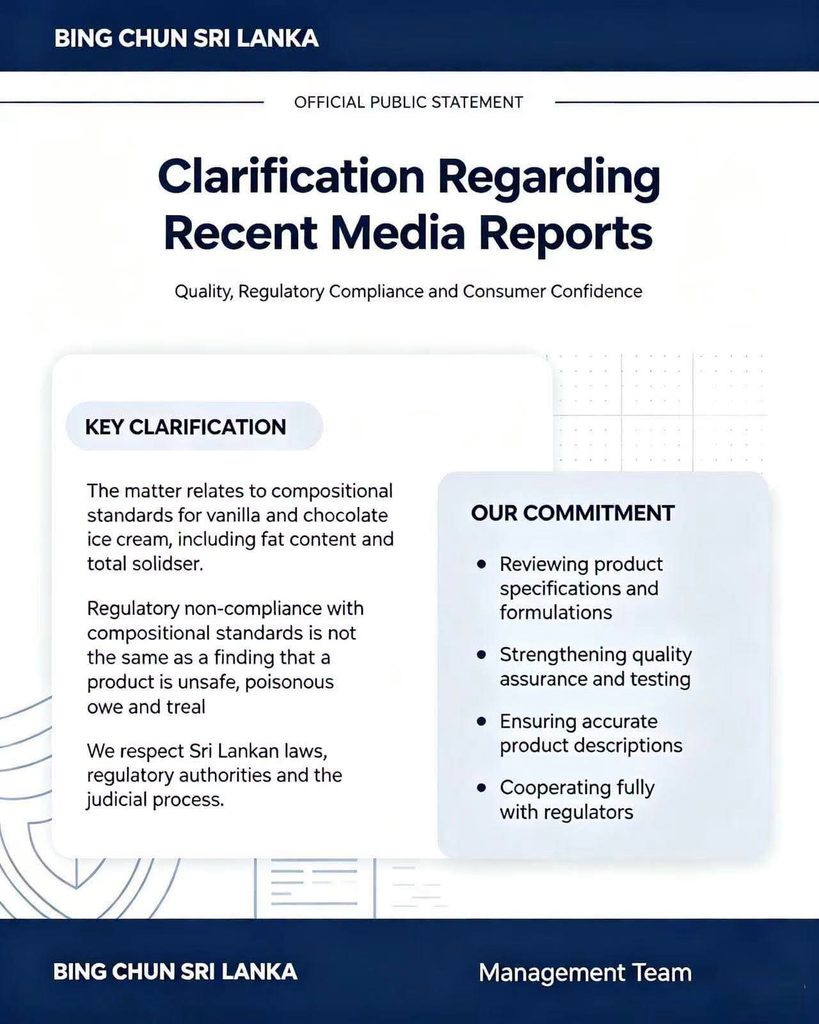
After unconditionally pleading guilty before the Maligakanda Magistrate’s Court to 28 counts of violating the Food Act and paying a fine of Rs. 84,000, how can the company now release a statement titled “Clarification Regarding Recent Media Reports” in a blatant attempt to hoodwink the consuming public?
“Yes, Your Honour” in Court – “We Did Nothing Wrong” Outside?
For a corporate entity that admitted guilt before the judiciary to subsequently issue press releases downplaying the gravity of that conviction is a flagrant deception of the public. Being convicted on not just one or two, but 28 separate counts clearly demonstrates that this was no mere administrative oversight, but a calculated operation that misled consumers.
Assuming that an offence substantiated with evidence by Public Health Inspectors (PHIs) of the Colombo Municipal Council can simply be whitewashed by a press release makes a mockery of the judicial process itself. Although the company claims in its statement that it “fully respects the laws and judicial processes operating in Sri Lanka,” advancing arguments that contradict a court verdict to mislead the public exposes the hollowness of its professed respect for the law.
Can a Defective Garment Be Equated to Food Consumed by Children?
A specification defect in a consumer good, such as an item of clothing or a pair of shoes, cannot be equated to the safety and compositional standards of food that directly enters the human body. Particularly when it comes to a confection like “ice cream,” which is immensely popular among young children, schoolchildren, and youth in Colombo, statutory food standards are a fundamental prerequisite directly tied to public health.
The Compositional Fraud Masked by Claims of Being “Non-Toxic”
Under the “Clarification of Key Facts” section of its statement, the company attempts to argue that the issue with its Vanilla and Chocolate ice cream products pertained solely to “compliance with requirements regarding Fat Content and Total Solids,” asserting that this “does not equate to a determination that the products are unfit for human consumption, toxic, or hazardous to health.”
This argument is a sheer travesty. Under Sri Lanka’s Food Act, for any product to be legally labelled and marketed to consumers as “ice cream,” it must contain a legally mandated minimum percentage of milk fat and total solids. Marketing a substandard mixture composed merely of water, sugar, artificial flavourings, and thickeners—devoid of the required nutritional composition—under the name of “ice cream” constitutes a twofold violation.
Defrauding consumers by taking their money under false pretences.
Depriving young children of the legitimate nutritional value they are entitled to receive.
Did Standards Only Come to Mind After the Raid?
Under the “Our Commitment” section of its statement, the company itself concedes that it is only now taking steps toward “reviewing product standards and compositions,” “strengthening quality control and testing processes,” and “accurately naming and describing products.”
The most critical question arising here is why, as a foreign franchise opening outlets in densely populated commercial hubs like Slave Island, the company failed to comply with the standards of Sri Lanka’s Food Act and accurately label its products before selling food to the public. Why did it show such disregard for the law of the land until caught red-handed by Public Health Inspectors and fined in court?
Threatening Legal Action Against Media Reporting the Truth
Despite standing convicted in a court of law, these parties have also attempted to issue veiled threats to the press by hinting at legal action over reports that allegedly damage the company’s reputation. Threatening legal repercussions against reporting a court verdict—where guilt was admitted in open court based on a City Analyst’s report—in the public interest is a grave affront to press freedom and the public’s right to information.
Consumer rights advocates strongly emphasize that instead of hiding behind technical jargon to further mislead the public, the company must strictly adhere to statutory food standards, while regulatory authorities must exercise far greater vigilance over the operations of such foreign franchises.
-By HariDeshaya.lk Special Correspondent