




: Health Ministry Official Admits to Clerical Errors in “Isolez” Documents Before Trial-at-Bar
(Based on the Court Proceedings of May 05, 2026)
The ongoing trial concerning the controversial procurement of substandard antibody vaccines (Human Immunoglobulin and Rituximab) witnessed significant developments before the Permanent High Court Trial-at-Bar. The case, involving 12 defendants including former Health Minister Keheliya Rambukwella, centers on indictments filed by the Attorney General for criminal conspiracy and the misappropriation of Rs. 144.4 million in state funds.
During the hearing on May 05, 2026, the cross-examination of a key prosecution witness highlighted administrative vulnerabilities, clerical omissions, and systemic flaws inherent in the Ministry of Health’s emergency procurement process.
The proceedings were held before a three-judge bench of the Permanent High Court Trial-at-Bar, comprising High Court Judges Priyantha Liyanage (President), Viraj Weerasuriya, and Thilakarathne Bandara.
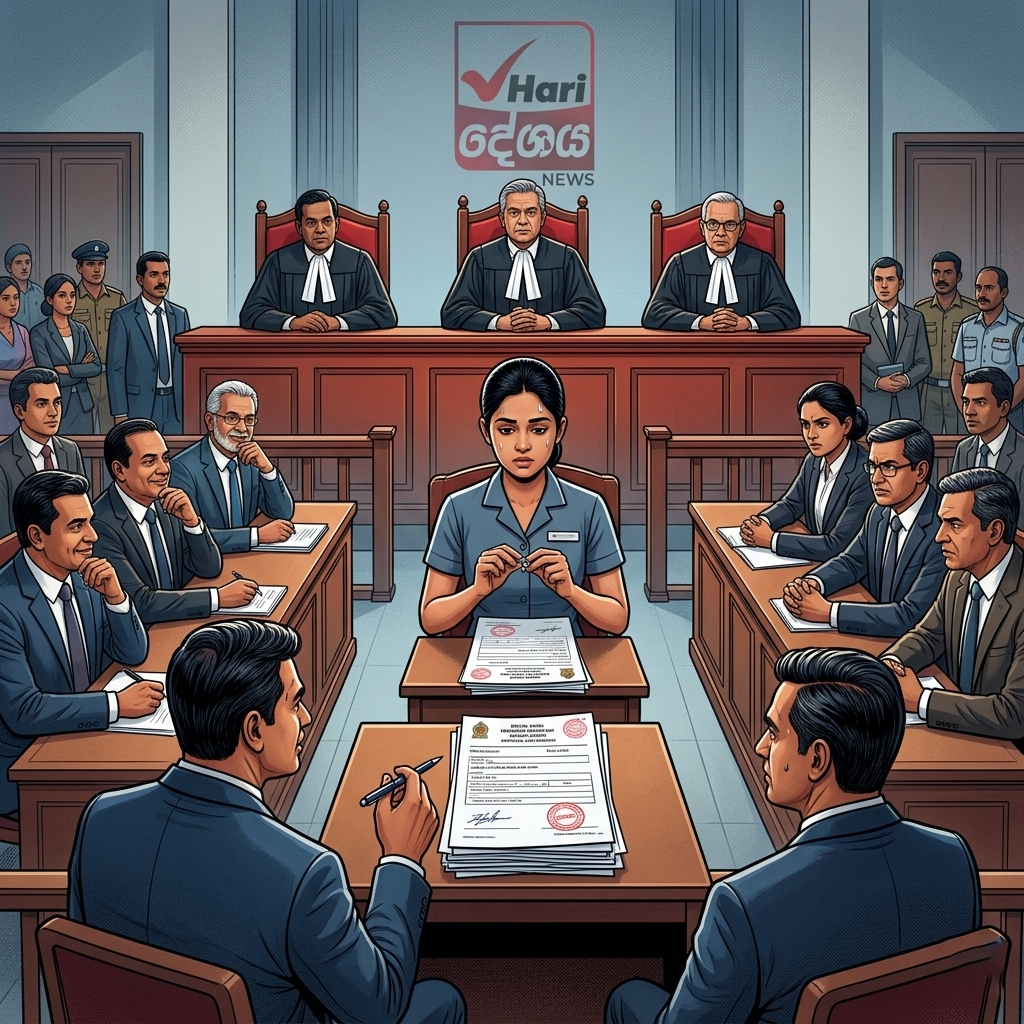
Following the conclusion of her examination-in-chief last week, Kalpana Tharindi Dabare, a Development Officer at the Ministry of Health and the 150th witness for the prosecution, faced intense cross-examination. Her explicit admission before the court that inadvertent clerical errors occurred during the drafting of critical procurement documents appears to bolster the overarching defense strategy strongly.
Clerical Omissions and Defense Strategy (Cross-Examination on behalf of the 11th Accused)
Attorney-at-Law Amitha Ariyarathne, representing the 11th accused, Dr. Thusitha Sudarshana (Director of the Medical Supplies Division – MSD), directed his cross-examination primarily at the witness’s role in the preparation of documents.
A crucial point of contention was the summary documentation related to the supplier of the Rituximab drug. The witness conceded that when entering the name of the bidding company into the summary sheets, the suffix “AG” was mistakenly omitted from “Isolez Biotech Pharma AG.”
Defense Counsel: Look at the document marked 241(A)2. What is the name of the supplier? Witness: It states ‘Isolez Biotech Pharma AG’. Defense Counsel: You prepared the relevant summary document. Do you see an error in it? Witness: Yes, My Lord. Defense Counsel: A part of the name is missing, isn’t it? Witness: It only states ‘Isolez Biotech Pharma’. The ‘AG’ is not mentioned. Defense Counsel: Was that an oversight? Witness: Yes, an oversight. Defense Counsel: Can such clerical errors occur? Witness: Such oversights can happen when preparing these types of documents.
Critical Analysis:
Through this exchange, the defense strategically demonstrated that certain anomalies within the procurement records might be attributed to low-level clerical errors rather than a deliberate, orchestrated fraud. Furthermore, the witness emphasized her lack of technical awareness regarding zero-stock levels of the drugs, asserting that she merely operated as a typist fulfilling directives.
Witness: “No, I only typed what was given to me. I cannot comment on the content.”
Accountability, Approvals, and Guidelines (Cross-Examination on behalf of the 2nd Accused)
Attorney-at-Law Asela Serasinghe, representing the 2nd accused, shifted the focus toward the composition of the evaluating committees and their collective accountability. A pivotal issue raised was why high-ranking officials, such as Chief Internal Auditor Mrs. C.H.R.M. Premathunge, who sat on the evaluation committee, failed to flag these discrepancies at the time.
Defense Counsel: Shouldn’t an Internal Auditor be vigilant when executing such duties? Witness: [Acknowledged that Mrs. Premathunge currently serves as the Chief Internal Auditor at the Ministry]. Defense Counsel: Who instructed you to type “MSD 1” on the document marked 6v6? Witness: It was typed upon the instructions of Mr. Buthpitiya. Defense Counsel: That is incorrect, isn’t it? Witness: I do not know whether it is right or wrong. I just typed it according to the instructions given to me.
The defense also questioned her knowledge of procurement guidelines, specifically referring to document 229 regarding the Waiver of Registration (WOR). When asked if the provision allowing unregistered suppliers offering the lowest bids to supply drugs was a formal guideline, the witness evaded a direct answer, reiterating that she only knew “WOR” stood for “Waiver of Registration” and lacked further procedural knowledge.
Official Designations and the Execution of Orders (Cross-Examination on behalf of the 9th Accused)
Representing the 9th accused, Attorney-at-Law Rahul Jayathilake scrutinized the witness’s official designation and the statements she had previously provided to the Criminal Investigation Department (CID) over four separate occasions.
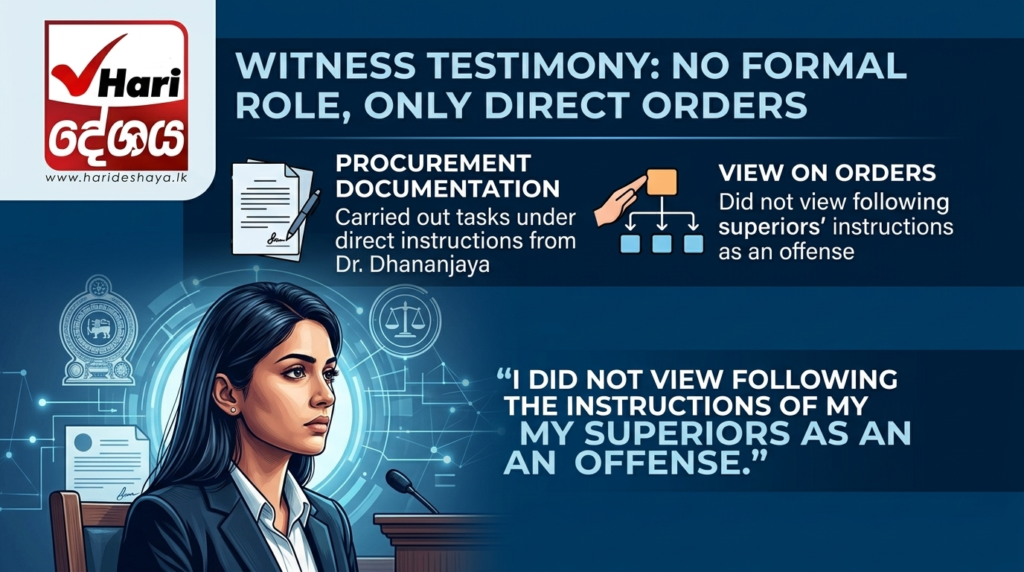
Defense Counsel: You are a Development Officer, correct? Witness: Yes, My Lord. Defense Counsel: Are you a Procurement Officer? Witness: I have engaged in procurement-related duties. Defense Counsel: Do you possess an official letter of appointment as a Procurement Officer? Witness: There is no such appointment. However, I handled tasks related to procurement. Under those circumstances, I could be referred to as a Procurement Officer.
She testified that although she lacked formal appointment to the role, she carried out procurement documentation under the direct instructions of Dr. Dhananjaya. The witness maintained that she did not view following the instructions of her superiors as an offense.
Overall Analysis and the Trajectory of the Trial
Operating strictly within the ethical boundaries of journalistic reporting and respecting the sub judice nature of the proceedings, an analysis of the testimonies reveals a clear trajectory in the defense’s strategy.
The defense is systematically attempting to illuminate the systemic failures, communication gaps, and administrative negligence that plagued the entire procurement apparatus. By establishing that subordinate clerical staff were mechanically executing orders without technical comprehension of stock levels or NMRA regulations, the defense seeks to dilute the prosecution’s narrative of a calculated conspiracy. Furthermore, highlighting the failure of internal auditing mechanisms and senior committee members to detect these anomalies at the time challenges the presence of mens rea (criminal intent) solely among the accused.
As one of the most monumental medical procurement scandals in Sri Lanka’s recent history—featuring indictments against prominent political figures, high-ranking NMRA officials, over 350 witnesses, and nearly 300 exhibits—the trial remains highly scrutinized.
(The High Court has directed that the cross-examination of this witness by the defense will continue for another two days in the upcoming sessions).