




Sri Lanka’s greatest post-crisis challenge may no longer be escaping economic collapse, but accumulating enough genuinely usable foreign exchange to ensure that the country does not fall back into external debt repayment default when the protection of the current IMF programme disappears.
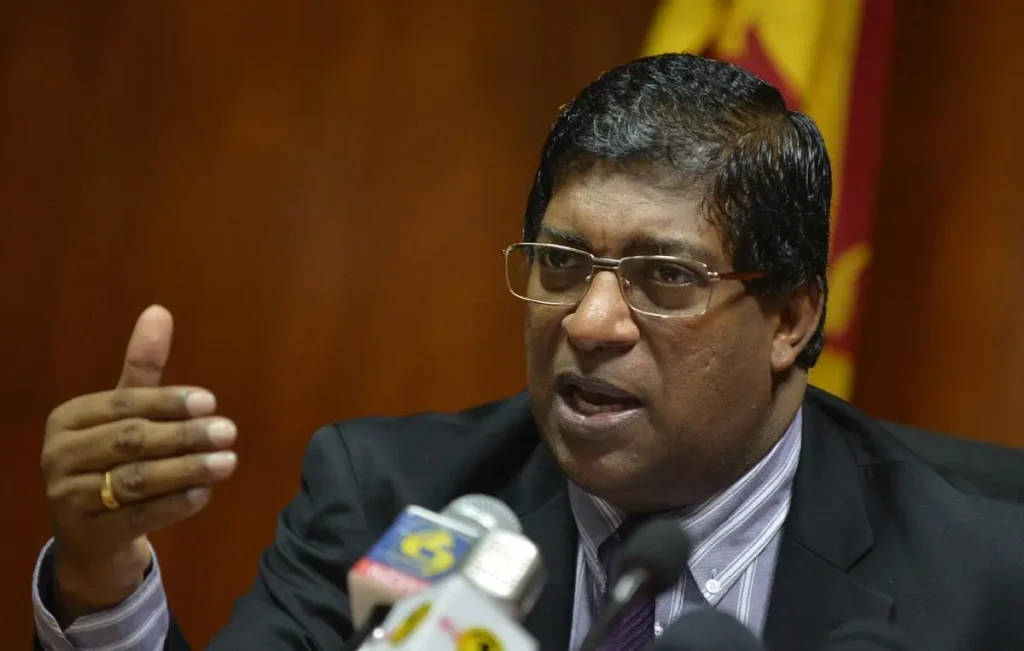
With the National People’s Power (NPP) government approaching its next IMF evaluation, former Finance Minister and MP Ravi Karunanayake has warned that Sri Lanka is entering a dangerous phase in which headline reserve figures may provide less protection than they appear to offer. The country has completed 94 percent of its public external debt restructuring, but the period after the IMF programme concludes in December 2026—and particularly beyond mid-2027—could expose a renewed foreign-exchange vulnerability.
The immediate target is to lift gross official reserves to US$8 billion by the end of 2026. Karunanayake argues that this is mechanically achievable through continued exporter-conversion requirements and heavy tariff surcharges, including the extended 50 percent surcharge on vehicle imports. But the much larger government target of US$15.1 billion by 2028 presents a substantially tougher test.
That target matters because Sri Lanka’s restructured debt-servicing obligations will increasingly return as a call on scarce foreign currency. Without a substantial reserve buffer, rising external debt payments could collide with import requirements and other foreign-exchange demands, creating a balance-of-payments crisis and potentially forcing the country to seek an 18th IMF successor programme to prevent another default.
The concern is intensified by the composition of existing reserves. Headline gross official reserves of approximately US$6.59 billion appear reassuring, but Karunanayake says the figure includes a non-usable US$1.4 billion, equivalent to RMB10 billion, swap with the People’s Bank of China, as well as short-term swaps with domestic commercial banks.
Official reserves were around US$6.1 billion in September 2024 and are now reported at US$6.491 billion. Yet unencumbered net international reserves remain negative at US$1.268 billion. Karunanayake has therefore demanded detailed projections for both gross and net reserves through 2029, information on IMF reserve targets, forward-contract liabilities and the actual amount of liquid foreign currency available to finance imports.
The Central Bank has been strengthening its position by purchasing excess dollars from commercial banks with newly created rupees. Net dollar purchases reached US$348.6 million in July, helping push the NIR position nearly US$700 million above the IMF review-period floor of negative US$2.035 billion.
But accumulating reserves cannot come entirely through monetary intervention without consequences. The Central Bank’s surprise 100-basis-point rate increase to 8.75 percent in May helped stabilise the rupee at Rs.332.75–332.95 per US dollar and anchor inflation expectations amid Middle Eastern energy shocks. Karunanayake argues, however, that tighter monetary conditions also restricted credit and squeezed SMEs.
Meanwhile, inflation has slowed to 6.8 percent without reducing the high cost of living. Prices have stabilised at elevated levels, real wages remain below the purchasing power lost during the cumulative 100 percent-plus inflation surge, and the 18 percent VAT on essentials and aggressive income-tax brackets have further reduced household disposable income.
This creates the central policy dilemma: Sri Lanka needs to accumulate foreign reserves rapidly enough to guarantee future debt payments, but cannot indefinitely extract the resources required to do so from households and businesses already under pressure.
Karunanayake has also questioned whether reserve accumulation is being handled with sufficient institutional accountability, asking whether responsibility lies with the Central Bank or Ministry of Finance. He has sought transparency over the Central Bank’s 2025 profits and remittances to the government, and asked whether the Active Liability Management Act should be activated to reduce debt-servicing costs and support the rupee.
The warning is ultimately straightforward: Sri Lanka cannot rely on accounting definitions of reserves when future creditors demand real dollars. The country needs a larger, transparent and genuinely liquid foreign-exchange cushion before debt servicing intensifies. Failure to build that buffer during the remaining period of IMF support could leave Sri Lanka confronting the same problem it sought to escape an external debt repayment crisis driven by insufficient dollars.