




The government’s accelerated drive to redevelop the long-idle Trincomalee Oil Tank Farm has entered a decisive phase, with international investors being invited to compete for one of Sri Lanka’s largest strategic energy infrastructure projects in a move expected to attract hundreds of millions of dollars in foreign investment while strengthening the country’s long-term energy security.
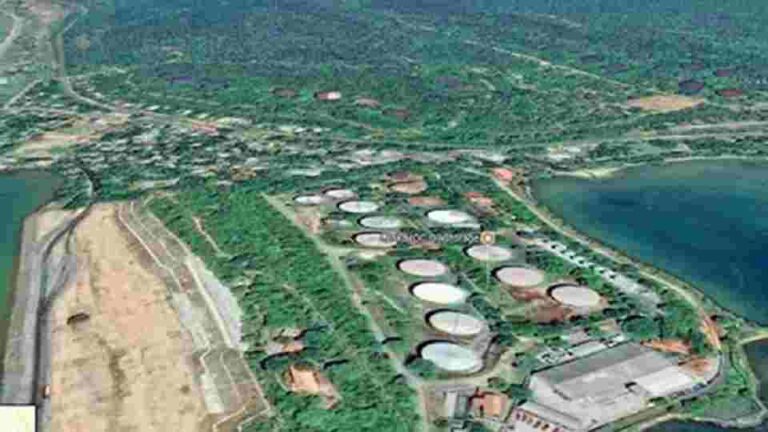
Senior officials of the Ceylon Petroleum Corporation (CPC) confirmed that Trinco Petroleum Terminal Ltd. (TPTL) has officially launched the process to issue an international Request for Proposals (RFP) for the redevelopment and commercialisation of 29 of the 61 oil tanks under its management. The Cabinet Appointed Negotiation Committee (CANC) has already granted approval for the tender process, clearing the way for foreign and local investors to submit proposals.
The development comes as the government positions the World War II-era oil tank complex as a cornerstone of Sri Lanka’s future energy strategy. Foreign Minister Vijitha Herath recently described the Trincomalee Oil Tank Farm as the country’s “permanent solution” to recurring fuel crises, arguing that expanded storage capacity would reduce the vulnerability of the domestic market to supply disruptions arising from geopolitical conflicts in West Asia and other oil-producing regions.
The project carries significant economic implications beyond energy security. Officials estimate that modernising the ageing infrastructure will require investments worth several hundred million dollars. By relying on international private investment rather than direct government borrowing, Sri Lanka expects to modernise a critical national asset without increasing its sovereign debt burden.
Investigations reveal that the redevelopment will not alter the existing ownership structure of the strategically important facility. The 99-tank complex continues to operate under a 50-year lease arrangement divided among three entities. CPC directly manages 24 tanks, Lanka IOC controls 14 tanks under a separate lease agreement, while TPTL retains responsibility for 61 tanks, of which 29 are now being offered for commercial redevelopment.
Energy Ministry officials stressed that Lanka IOC’s operations remain entirely unaffected by the latest investment initiative. Instead, the tender forms part of the broader Tripartite Energy Hub framework signed in 2025 between Sri Lanka, India and the United Arab Emirates, designed to position Trincomalee as a regional energy logistics centre.
India has consistently urged faster implementation of the project. During his recent visit to Colombo, Indian Foreign Secretary Vikram Misri welcomed the renewed momentum, stating that “there is no further time to lose in making progress on strategic projects such as these.” Diplomatic sources indicate New Delhi views the project as a critical regional energy buffer capable of stabilising fuel.