




Palaly International Airport in Jaffna has become more than an aviation project. It is increasingly a test of whether Sri Lanka’s economic recovery will reach the Northern Province, where improved air connectivity could unlock tourism, trade, investment and stronger links with India. But the airport remains trapped between expansion ambitions, land disputes, financial caution and painfully slow decision-making.
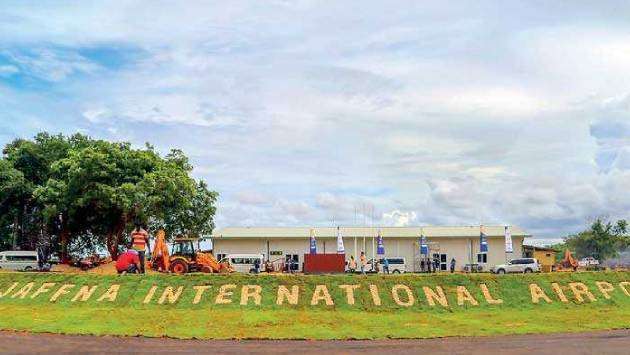
The Civil Aviation Authority has acknowledged that expansion is necessary, but says the amount of land required has still not been determined. The airport currently operates essentially as a regional gateway with basic approaches and aircraft facilities. Regular weekly services to India, particularly Chennai and Trichy, are operated by IndiGo and Air India, but the airport remains restricted largely to ATR-72 turboprops carrying about 70 passengers because its 1,400-metre runway cannot accommodate larger narrow-body jets.
That limitation has a direct economic cost. Larger Airbus A320 and Boeing 737 aircraft could bring greater passenger volumes, more competitive fares, additional destinations and increased opportunities for tourism and business. Instead, northern businesses remain dependent on a constrained aviation gateway precisely when the province needs stronger economic integration.
A new passenger terminal is under construction in two stages at a total estimated cost of Rs.700 million. Stage One is underway, while the Stage Two tender process advanced earlier this year to enlarge arrival and departure facilities. India had already provided a Rs.300 million grant for terminal modifications, power improvements and navigational systems.
But the much bigger Phase Two expansion remains unresolved. The plan is to extend the runway beyond 2,300 metres and enable narrow-body commercial jets. The project, estimated at more than US$60 million, is expected to depend on Sri Lankan Treasury funding, public-private partnerships and concessional Indian credit lines.
Land acquisition has become the most politically sensitive obstacle. Authorities have proposed expanding the runway, while northern Tamil politicians, including Gajendrakumar Ponnambalam, have accused the government of using development as a pretext for a potential “land grab” involving nearly 3,000 acres of civilian property in Valikamam North. Local politicians argue that immediate upgrades could be completed within the airport’s existing 359-acre footprint without displacing civilians.
The government therefore faces a difficult choice: protect civilian property while accelerating economic development, rather than allowing the dispute to become an excuse for indefinite delay.
India’s strategic involvement adds another dimension. New Delhi has already demonstrated its interest in northern infrastructure through a separate US$60 million grant for renovating Kankesanthurai Port. Palaly therefore sits within a broader Indian connectivity strategy.
Past geopolitical tensions also slowed the project, with India’s Ministry of External Affairs and Airports Authority of India previously holding back cooperation during Sri Lanka’s 2018–2019 political crises.
Today, however, the obstacle is principally domestic: fiscal constraints, feasibility studies and slow tender procedures. Transport Minister Bimal Rathnayake has insisted that major expansion undergo rigorous commercial feasibility assessment to prevent another Mattala-type financial failure.That caution is understandable. But excessive caution can become another form of policy paralysis.
If the NPP Government genuinely wants the Northern Province to participate in Sri Lanka’s economic recovery, it must now establish a clear timetable, settle the land question transparently, complete feasibility work and move the expansion toward implementation. Otherwise, Palaly risks remaining a gateway with enormous potential but permanently insufficient capacity.