




A half-built government office complex is returning to Sri Lanka’s development agenda, but its revival comes with a price tag that demands closer examination.
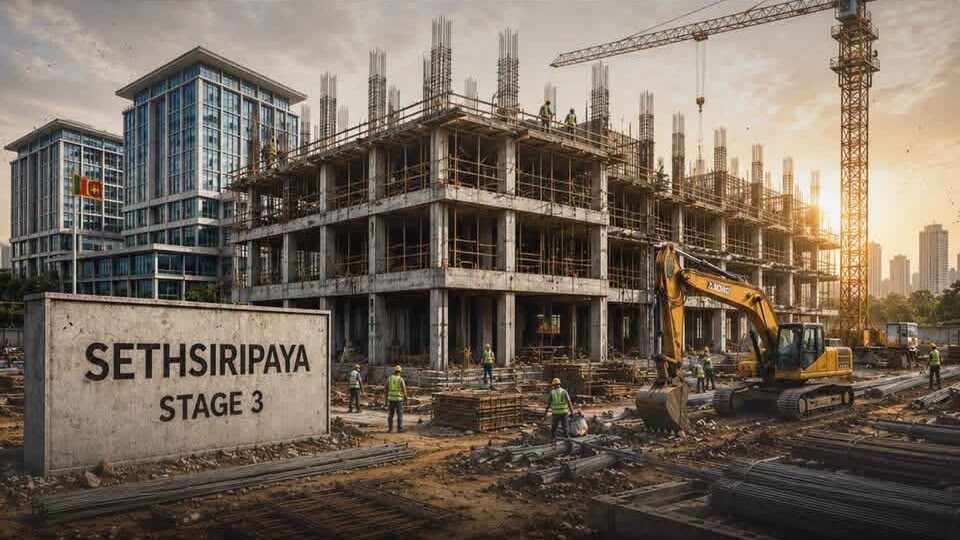
The Sethsiripaya Phase III project was initially conceived to meet growing demand for administrative office space among government and semi-government institutions. The Urban Development Authority launched the project with an estimated capital cost of Rs.16.7 billion. Construction began in 2021 and progressed to three floors before the project was suspended.
Five years later, the government is preparing to restart the work under a revised agreement with Maga Engineering (Pvt) Ltd worth Rs.25.58 billion. The total estimated project cost has reached Rs.38.48 billion, including previous expenditure, remaining construction, additional project costs and taxes.
The government says the suspension was caused by extraordinary economic circumstances. Sri Lanka faced shortages of raw materials, import restrictions, currency pressures and dramatic increases in construction costs. Both parties agreed to temporarily suspend the contract during the disruption.
Those circumstances help explain why the project stalled. They do not, however, answer the central question of whether the revived development remains economically justified at its new cost.
The original contractor has submitted a proposal to complete the project without changing its initial scope. After review by the Variation Review Committee, Maga agreed to complete the outstanding work for Rs.22.76 billion. The Cabinet has now approved the revised agreement valued at Rs.25.58 billion.
The government has attempted to distribute the financial burden through a joint financing model. Institutions receiving office space will contribute according to the amount of space allocated to them. The identified occupants include the Ministry of Power, the Department of Inland Revenue, the State Pharmaceuticals Corporation and the UDA.
This approach creates an obvious policy question: how much office space does each institution actually require, and what financial benefit will the state obtain from consolidating these functions in one complex?
The answer matters because government office accommodation represents more than construction expenditure. There are long-term costs involving maintenance, utilities, security, transport and staffing. A building that is expensive to construct can become even more expensive to operate if occupancy and space allocation are not carefully managed.
At the same time, abandoning Sethsiripaya Phase III would not necessarily be the cheaper option. Money has already been spent, and a partially completed 25-storey structure represents a substantial sunk investment. Restarting construction may therefore be economically preferable to leaving the asset unfinished.
The challenge is ensuring that the decision to continue is based on current needs rather than simply on the money already spent.
Maga’s extensive record in Sri Lanka’s infrastructure sector, including roads, bridges, high-rises, water projects and public buildings, gives the contractor substantial experience. Yet contractor experience alone cannot determine whether the state receives value for money.
The revived project now requires transparent monitoring from procurement through completion. Detailed disclosure of expenditure, construction milestones, variations and institutional contributions would allow the public to assess whether Sethsiripaya Phase III is finally becoming an efficient government asset or another costly reminder of projects that outlive their original budgets.