




Sri Lanka’s proposed $18 million overhaul of four Mi-17 helicopters and delaying of procurement tender has raised important questions about how major defence maintenance contracts are awarded, verified and monitored when the required technical expertise is unavailable locally.
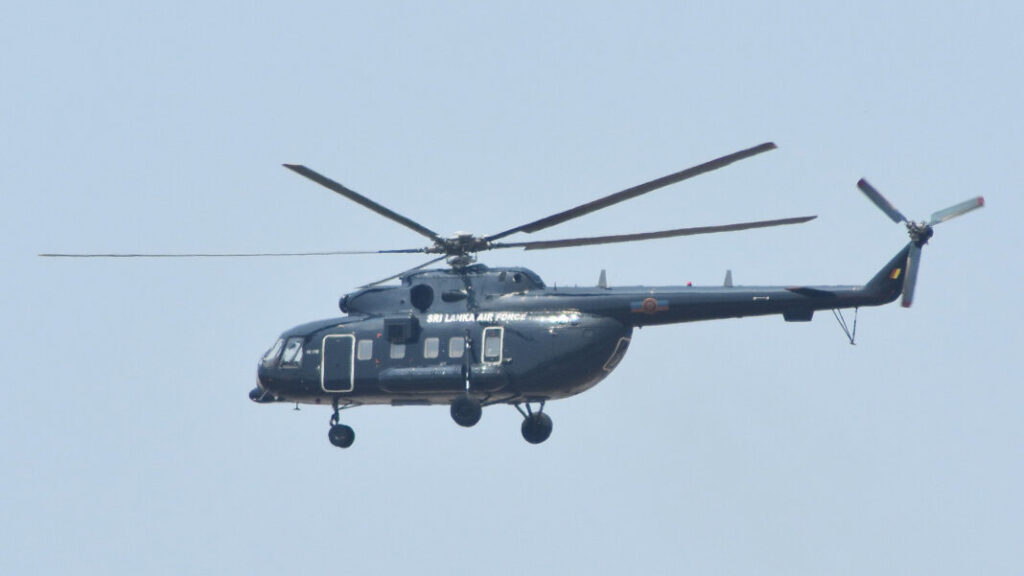
The helicopters SMH 599, SMH 596, SMH 588 and SMH 4416 are part of an ageing fleet that requires specialised maintenance because of its Soviet-era design and the difficulty of obtaining certified components. The contract was awarded to Winsley Defence Group d.o.o. of Bosnia and Herzegovina, with Securatec Lanka (Pvt) Ltd acting as the local agent.
The arrangement reflects the structure of Sri Lanka’s defence procurement system. Foreign companies provide specialised engineering services, certified parts and overseas overhaul facilities, while local agents handle tender submissions, bid securities, regulatory requirements, financial transactions and communications with government procurement authorities.
This system can be necessary when Sri Lanka lacks the facilities to undertake major aircraft overhauls. But it also creates risks if the qualifications of foreign contractors, local representatives and overseas repair facilities are not independently verified.
The Mi-17 contract has attracted complaints concerning the technical and regulatory credentials of the proposed repair arrangements. One of the major questions concerns the requirement for original equipment manufacturer approval or equivalent certification. Critics have alleged that the selected contractor did not demonstrate the required level of authorisation.
Questions have also been raised about the proposed Georgian repair facility. According to material cited in complaints, the Georgian Civil Aviation Authority issued a “no objection” letter, while noting that the helicopters had not been registered under its jurisdiction since 2022. Whether such documentation satisfies the procurement requirements should be determined through an independent technical and legal review.
Another concern is the reported request to conduct some repair work in Sri Lanka after the contract had been awarded for an overseas overhaul. Any change to the original scope should be subjected to the same technical and financial scrutiny as the initial tender.
The procurement process should also address pricing. At approximately $4.5 million per helicopter, the contract needs a clear breakdown of labour, spare parts, specialist services, transportation, and insurance, testing and subcontracting costs. Without such information, independent auditors face difficulty determining whether the price represents reasonable market value.
A revised procurement system should therefore introduce several safeguards. OEM or aviation-authority approvals should be independently confirmed before contract award. All subcontractors and major suppliers should be disclosed. Local agents should declare their ownership and financial interests. Overseas repair facilities should be subject to independent verification and inspection.
Emergency operational requirements should not remove these safeguards. The condition of the Mi-17 fleet may affect disaster relief, transport and international peacekeeping commitments, but urgency should lead to faster scrutiny not weaker scrutiny.
The central issue is not whether foreign contractors should be used. Sri Lanka may have no practical alternative for certain complex aircraft repairs. The issue is whether every contractor, agent, facility, component and payment can be independently verified.
A stronger procurement system would allow the Air Force to restore aircraft faster while protecting public funds and preventing technical uncertainty from becoming a gateway to abuse.