




Sri Lanka’s newly passed Inland Revenue (Amendment) Bill has ignited fierce national debate, with critics warning that the Government’s latest tax enforcement drive risks criminalising ordinary citizens while failing to address deep-rooted weaknesses within the country’s tax administration system.
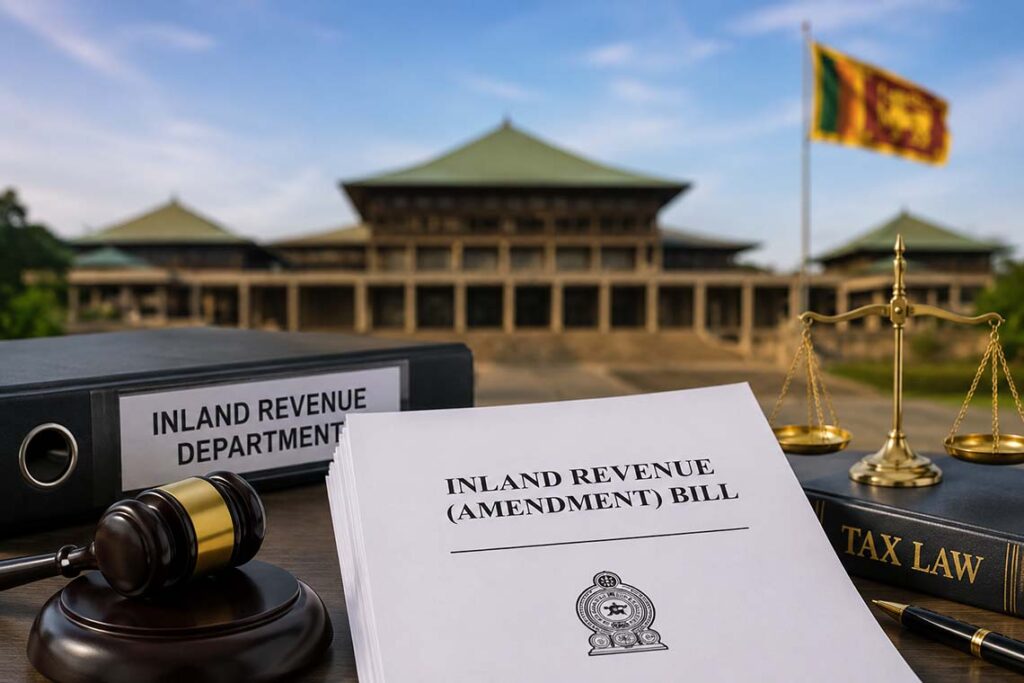
Passed in Parliament amid strong opposition protests, the law introduces sweeping powers for the Inland Revenue Department (IRD), including criminal penalties for certain tax compliance failures. Under the amendments, individuals who fail to file annual income tax returns, fail to obtain a Tax Identification Number (TIN), or fail to appear before the IRD when summoned could face fines of up to Rs. 400,000, imprisonment of up to six months, or both.
The Government insists the measures are necessary to improve revenue collection under Sri Lanka’s IMF-backed fiscal recovery program. However, legal experts and opposition politicians argue that the amendments represent a dangerous shift from administrative enforcement toward criminal prosecution.
The controversy intensified after multiple petitions challenged the Bill before the Supreme Court. One of the most contentious provisions, Clause 31(4), was effectively withdrawn after the Court ruled it unconstitutional in its original form. The clause would have allowed disputed tax liabilities to be treated as criminal fines recoverable through Magistrate’s Courts, even while taxpayer appeals remained pending.
Although the Court intervened to impose procedural safeguards, another controversial section — Clause 34 introducing Section 185A survived judicial scrutiny. The provision now criminalises specific compliance failures, provided taxpayers are first notified and given 30 days to rectify violations.

Opposition MP Kabir Hashim described the amendments as a major transformation in the relationship between the State and citizens. According to him, a successful tax system depends on trust, fairness, and institutional credibility rather than coercion.
Critics argue that Sri Lanka’s tax crisis stems less from weak laws and more from poor administration and selective enforcement. Large-scale tax leakages, unresolved VAT arrears, and massive corporate tax exemptions remain key concerns. Opposition lawmakers pointed out that tax arrears reportedly exceeded Rs. 1.6 trillion in 2023, while billions in unpaid VAT remain under-collected.
Questions are also being raised about whether the Government has modernised the IRD sufficiently before introducing harsher penalties. Authorities had promised to digitise operations, integrate the Revenue Administration Management Information System (RAMIS) with multiple Government agencies, and recruit thousands of professionals. Yet many of those reforms remain incomplete.
President’s Counsel Faiszer Musthapha warned that ordinary taxpayers unfamiliar with complex tax procedures could become unintended victims of the new system. He stressed that administrative oversight should not automatically be equated with deliberate tax evasion.

The Government, however, maintains that only wilful tax evaders need to worry. Deputy Minister Chathuranga Abeysinghe argued that prolonged litigation and weak enforcement had crippled revenue collection for years. According to him, the new law provides sufficient opportunities for taxpayers to comply before legal action is initiated.
The broader concern, however, extends beyond taxation alone. Analysts warn that excessive enforcement powers, if exercised arbitrarily, could undermine public trust and discourage entrepreneurship during a fragile economic recovery.
As Sri Lanka struggles to rebuild after its worst economic crisis in decades, the Inland Revenue amendments may ultimately become a test of whether fiscal reform can coexist with democratic accountability and public confidence in governance.
By a Special Correspondent