




Sri Lanka’s Avant Garde maritime-security controversy is no longer simply a question of who controlled floating armouries. The financial figures now emerging indicate that the arrangement potentially cost the State millions of US dollars in revenue that could otherwise have strengthened foreign-exchange reserves and the Consolidated Fund.
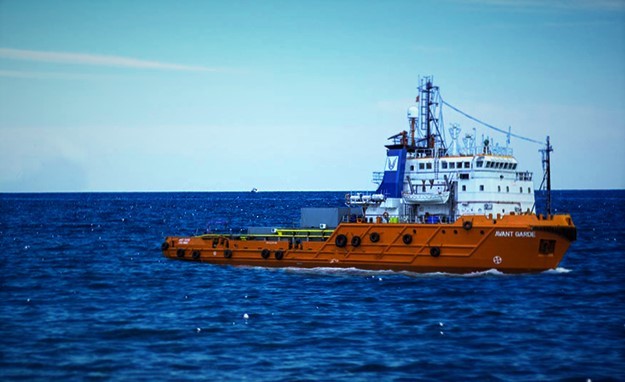
The most revealing comparison comes from the period when the operation was returned to direct Navy control. Between October 3, 2025 and February 8, 2026, the Sri Lanka Navy conducted 323 maritime-security operations and transferred US$598,250 directly to the Government Consolidated Fund. The Defence Ministry says the Navy already possessed most of the infrastructure and personnel required, meaning the operation could be expanded with minimal additional expenditure.
That figure provides a useful benchmark for assessing the previous public-private model.
According to information presented before the COPE Sub-Committee, the operation was generating approximately US$400,000 a month, with about 80 percent going to the private partner. Another report based on the Navy’s historical revenue structure puts Avant Garde’s share at 80.75 percent, Rakna Lanka at 4.25 percent and the Navy at 15 percent.
Using the US$400,000 monthly figure supplied in the document, the private share alone works out to approximately US$320,000 a month.
That means:
- One year: US$3.84 million
- Three years: US$11.52 million
- Four years: US$15.36 million
- Five years: US$19.20 million
- Ten years: US$38.40 million
These calculations are not a final legally established loss to the Treasury. They represent the value of the reported 80-percent monthly share if the stated US$400,000 monthly revenue continued throughout the relevant period.
There is, however, a much firmer historical benchmark. Officially reported figures show that the previous joint venture generated approximately US$14.12 million between September 2021 and July 2025. Under that structure, Avant Garde received 80.75 percent, while the Navy received 15 percent and Rakna Lanka 4.25 percent.
On US$14.12 million, an 80.75-percent share represents approximately US$11.40 million. The Navy’s 15 percent share would be about US$2.12 million, while Rakna Lanka’s 4.25 percent would be approximately US$600,000.
The foreign-exchange dimension is particularly important. At a time when Sri Lanka was struggling to obtain dollars for fuel, medicine and essential imports, the State was receiving only a fraction of foreign-currency earnings from an operation involving national security infrastructure and expertise.
There was also a separate unpaid amount. Reports citing Navy disclosures state that Avant Garde had not paid approximately Rs.782 million due to the Navy for services provided between December 2014 and November 2015.
An earlier National Audit Office report also identified Rs.1.63 billion owed by Avant Garde to Rakna Lanka as of March 2020, representing 91.4 percent of the company’s maritime-security receivables, while additional floating-armoury receivables had remained unrecovered for years.
The financial investigation therefore needs to go beyond the headline figure. Auditors must establish the total revenue generated, the exact private-sector share, unpaid dues, taxes, royalties, foreign-exchange retained outside the State system and the opportunity cost to the Treasury.
The Navy’s subsequent performance has strengthened the question. Within less than four months of taking direct control, it generated US$598,250 for the State.
The central issue is consequently no longer whether the State could operate the business.
It demonstrably can.
The unresolved question is how much public revenue was surrendered before that capacity was restored and who authorised it.