




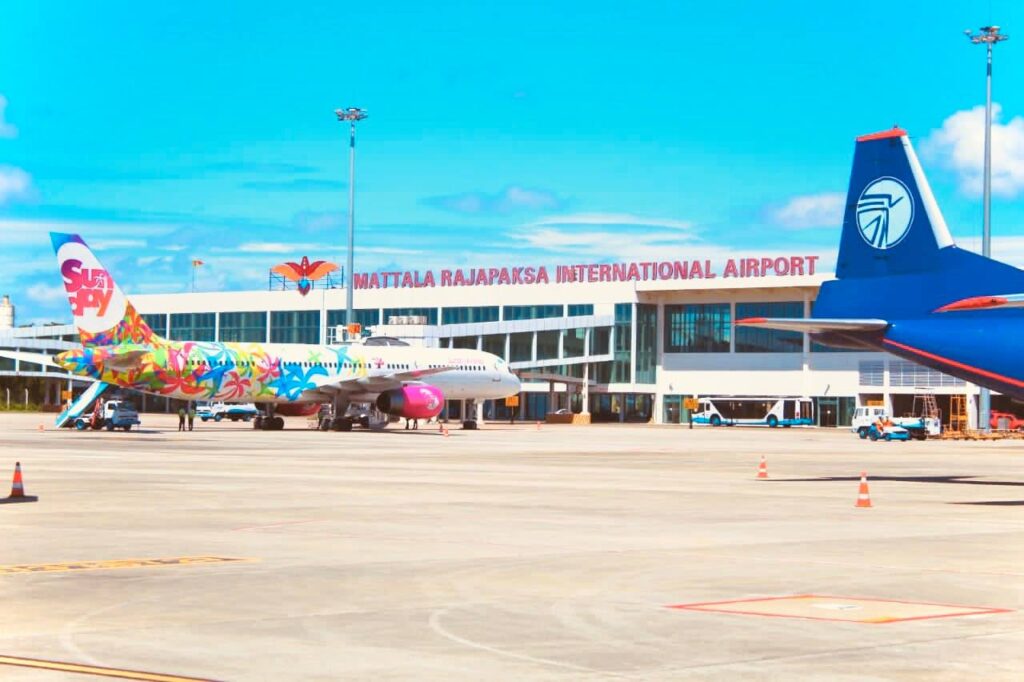
The financial damage surrounding Mattala Rajapaksa International Airport extends well beyond its reported Rs. 39.3 billion net losses. Auditor General investigations have exposed a chain of Treasury shortfalls, unused foreign credit lines, administrative failures and costly damage to the airport’s terminal, raising questions about how a public asset intended to serve the national economy became a continuing drain on state resources.
According to the document, the state aviation agency withheld mandatory dividend remittances to the Treasury, retaining nearly Rs. 9 billion that should have been transferred to the Consolidated Fund. The money was reportedly held as cash buffers to support Mattala’s operations.
The decision effectively deprived the Treasury of revenue while the airport continued to accumulate losses. It also illustrates the difficulty of assessing the true financial condition of state-owned enterprises when cash is retained within institutions rather than transferred through established public-finance channels.
A separate failure cost the Treasury Rs. 359.5 million in penalty commitment fees. The charges arose because foreign credit lines were not utilised within the required time. Rather than financing productive infrastructure or generating economic returns, public funds were spent because of delays and administrative incompetence.
The airport’s most extraordinary chapter involved its conversion into a grain-storage facility. With passenger traffic remaining weak, the terminal was reportedly used as a warehouse through an arrangement involving the Paddy Marketing Board. State funds were channelled as rent, creating a circular financial mechanism in which public institutions effectively paid to use another public asset.
The arrangement subsequently produced further damage. Rats reportedly destroyed electronic main switch panel rooms at the terminal, leaving taxpayers responsible for millions of rupees in structural and electrical repairs. The episode illustrates how the airport’s underutilisation created not only financial losses but also additional maintenance liabilities.
The government is now seeking to offload the burden through a new public-private partnership model targeted for 2027. However, an earlier Indo-Russian arrangement reportedly collapsed because of foreign sanctions, leaving the state to continue carrying the airport’s costs.
The proposed partnership raises questions about whether a private investor would assume the airport’s existing liabilities, whether the Treasury would absorb them, and what safeguards would prevent another politically driven financial arrangement.
The airport’s construction cost of US$243.7 million, including a US$34.7 million increase introduced without proper technical consultations, remains central to the accountability debate. So too does the reported daily operational deficit of up to Rs. 7 million.
Mattala’s story is therefore not simply one of low passenger numbers. It is a record of how public money was committed, retained, redirected and spent again to sustain an asset whose economic justification has repeatedly failed. Unless the government discloses the full financial obligations and establishes responsibility for the losses, any future partnership risks transferring the burden without resolving the underlying accountability crisis.