




High Court Trial Exposes State Negligence and Flawed Prosecutorial Evidence
The ongoing trial before the Colombo Permanent High Court-at-Trial concerning the procurement of substandard medicines has lifted the veil on a deeper institutional crisis. Beyond the immediate criminal charges, the cross-examination of Mohamed Jawas Abdul Cader, an IT Officer at the Ministry of Health, has exposed systemic failures within Sri Lanka’s healthcare bureaucracy and critical investigative lapses by the Criminal Investigation Department (CID).
For a trial of this magnitude, the forensic reliability of evidence is paramount. However, the courtroom proceedings revealed that the prosecution’s case relies heavily on flawed data management, raising serious questions about accountability.
System-Generated or Manually Altered?
A central point of contention raised by the defense was the integrity of documents ‘Prosecution Exhibit 293’ ($P293$) and ‘Prosecution Exhibit 294’ ($P294$). Rather than being unadulterated, automated system exports, it was revealed that critical data points had been manually inputted, creating potential margins for error.
Defense Counsel Nuwan Jayawardena: "Document P293 does not even carry a letterhead or a title indicating its purpose."

Witness: "No, it does not."

Defense Counsel: "You prepared document P294 as well. That too lacks a clear purpose. It has neither been checked nor approved by any superior officer, correct?"

Presiding Judge Priyantha Liyanage: "How exactly were these documents generated?"

Witness: "They were generated via the report module. The Pronto system allows for report generation."

Presiding Judge: "Did you look at the dates on the Pronto system and manually enter the data into an Excel or Word document?"

Witness: "The system generated them, but columns 1, 2, 3, 4, and 5 of document P293 were manually typed out by referencing the system. Document P294 is more complex; it is a document generated after copying data."

Defense Counsel: "Who entered the data into the columns lacking SR (State Registry) numbers in P293?"

Witness: "Another officer."
This exchange undermines the evidentiary weight of the prosecution’s primary documents. Introducing a document through a witness who cannot personally vouch for the integrity of its data creation creates a significant gap in the chain of custody.
The Missing Audit Trail: CID’s Investigative Oversight
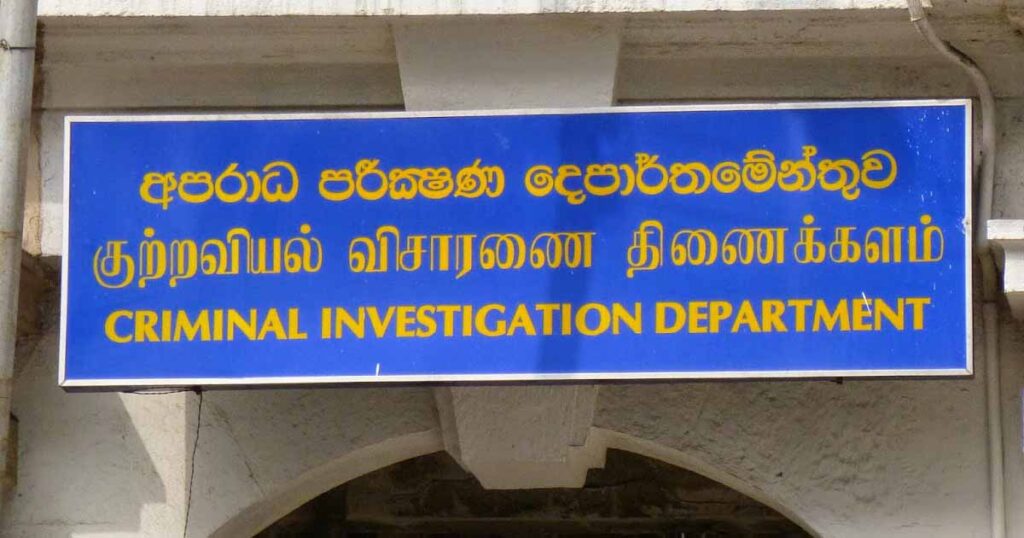
In digital forensics, the integrity of a database can only be verified through an ‘Activity Log’ or an ‘Audit Log’—the digital footprint that records every creation, modification, or deletion of data. In a startling revelation, the witness admitted that the CID completely bypassed this essential investigative step.
Defense Counsel Nuwan Jayawardena: "Explain to the court what an activity log is."

Witness: "It is an audit log. If any operation is performed on the system—whether data is entered, modified, or deleted—it can be viewed as an audit report."

Defense Counsel: "Can the authenticity and integrity of this data be verified through this activity log?"

Witness: "Yes."

Defense Counsel: "Did the Criminal Investigation Department at any point request this activity log?"

Witness: "No, Your Honour."
By failing to secure the audit logs, the prosecution has left itself vulnerable to the argument that the data presented could have been altered or compromised, weakening the technical foundation of their criminal charge.
Bureaucratic Inertia: The Five-Year ‘Pending’ Trajectory
The cross-examination also highlighted chronic inefficiencies within the Medical Supplies Division (MSD) and the State Pharmaceuticals Corporation (SPC), where life-saving ’emergency’ orders remained unfulfilled for years without administrative intervention.
Deputy Solicitor General Lakmini Girihagama: "Focus on column 5. It does not specify how you extracted the pending orders. Did you only include pending orders?"

Witness: "We extracted data for a maximum of 5 years—2018, 2019, 2020, and 2021, Your Honour."

Deputy Solicitor General: "How did the CID request this?"

Witness: "Orders that had been pending for nearly 5 years without any procurement taking place were removed."
The defense swiftly exploited this admission of systemic delay, pointing out that critical medications remained completely unavailable despite being categorized as urgent.
Defense Counsel Ashoka Serasinghe: "According to the 2020 order, 44,050 units were supposed to be received by September 2023. They were never received, correct?"

Witness: "Yes, Your Honour."

Defense Counsel: "The letter 'E' used in 2V 28 denotes an Emergency Order, correct? And it refers to Human Immunoglobulin?"

Witness: "Yes."

Defense Counsel: "So, even though it was flagged as an emergency order, it had still not arrived by 2023?"

Witness: "Yes."
Compounding this administrative dysfunction, the prosecution’s key data witness admitted to a total lack of expertise in the core regulatory frameworks governing the case.
Defense Counsel Ashoka Serasinghe: "Do you understand procurement procedures? Do you know the legal regulations?"

Witness: "No, Your Honour."

Defense Counsel: "You did not mention anything about the procurement process to the CID either, did you?"

Witness: "No."
Legal Epilogue

The High Court proceedings demonstrate that the substandard drug scandal is not merely an isolated instance of corruption, but the product of a profoundly negligent state apparatus.
However, as the trial progresses, the prosecution faces a steep uphill battle. The failure of investigators to secure raw, untampered digital metadata (the Activity Log), combined with reliance on manually transcribed summaries ($P293$), provides the defense with ample ammunition to argue reasonable doubt. For justice to be served, the prosecution must bridge these technical and procedural gaps, proving guilt not through fragmented administrative summaries, but through ironclad forensic verification.