




By a special correspondent
Recently, Minister of Power and Energy, Kumara Jayakodi, made a startling revelation in Parliament that captured the nation’s attention. He categorically stated that Sri Lanka’s power sector is not only plagued by the traditional oil and coal mafias, but a large-scale ‘Solar Mafia’ has now emerged under the guise of green energy. The Minister firmly vowed to dismantle this mafia, regardless of the obstacles in his path.
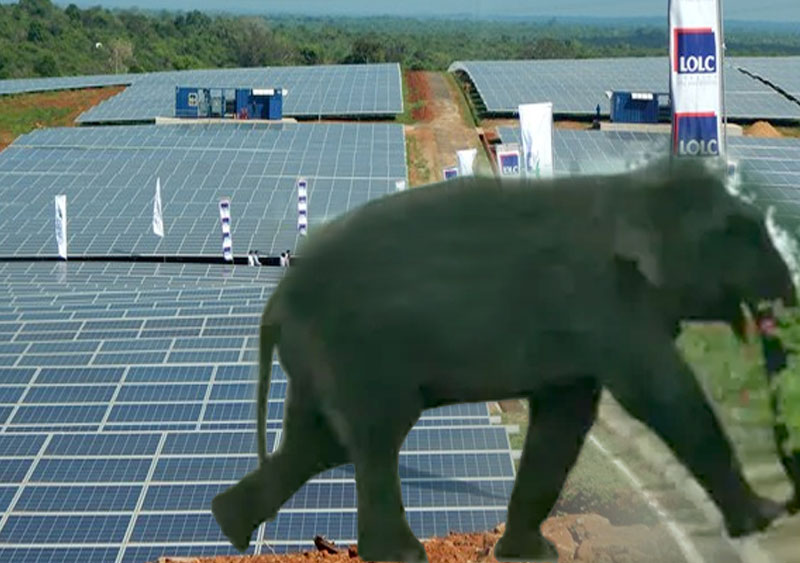
Providing real-time validation of the Minister’s grave claims, and raising serious questions regarding the state machinery, a shocking incident has been reported from Hambantota. Recent revelations by the Movement for Land and Agricultural Reform (MONLAR) perfectly illustrate the true nature and modus operandi of this so-called ‘Solar Mafia’.
A 14-Million-Rupee Indirect Bribe and Massive Deforestation
How this mafia operates, exactly as the Minister pointed out, is clearly visible around the Hambantota Elephant Management Reserve.
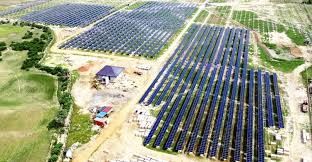
Although portrayed as a ‘Corporate Social Responsibility (CSR)’ initiative to construct a 12-kilometer hanging electric fence, environmental researcher Sajeewa Chamikara exposes this as a subtle, indirect bribe intended to secure re-approval for suspended projects. As a direct consequence, approximately 1,000 acres of vital forest land—the natural habitat of elephants in the Seenukkugala, Orukengala, and Kapapuwewa areas—have already been mercilessly bulldozed by this mafia.
It is reported that these activities are being carried out by several entities, namely: Dudu International Pvt Ltd, Nidhanya International Pvt Ltd, Tanu International Pvt Ltd, Tannish International Pvt Ltd, Orion Solar Pvt Ltd, Everrenew Energy Pvt Ltd, and Asian Solar Pvt Ltd.
A Monopoly Devouring SMEs
This critical analysis is by no means an opposition to the much-needed promotion of solar energy in the country. Solar energy is fundamentally a democratic power source that can yield significant economic benefits for the general public and Small and Medium Enterprises (SMEs).
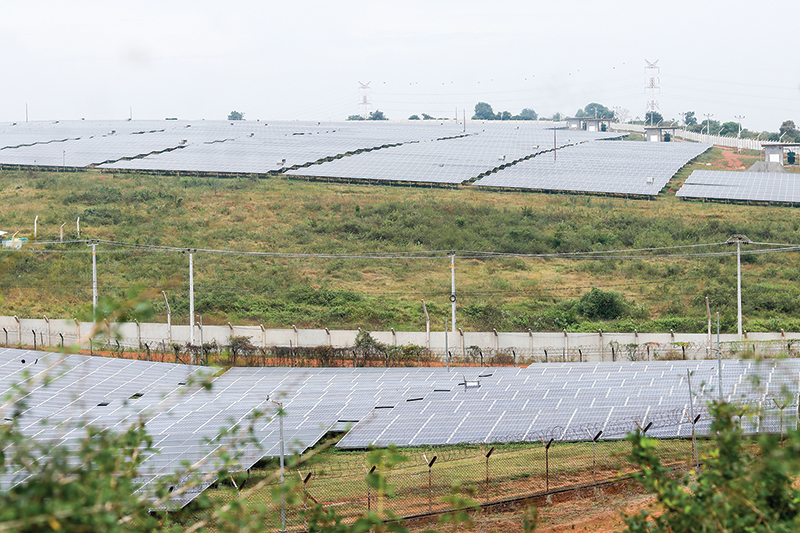
However, precisely as Minister Jayakodi hinted in Parliament, the current reality is that these opportunities are being snatched away from SMEs. The very same large-scale racketeers who previously thrived on the oil and coal monopolies are now plundering thousands of acres of state forests, turning the solar energy sector into a victim of massive monopolization.
Suspicious Interventions by Government MPs
The greatest tragedy here is that while the Minister exposes the mafia, certain representatives within the government itself appear to be facilitating it. During the tenure of the previous government, it was the current National People’s Power (NPP) Member of Parliament, Nihal Galappaththi, who actively intervened to suspend these exploitative projects.
Yet, MONLAR alleges that the recent process of securing the 14-million-rupee funding from the relevant companies occurred under the guidance and coordination of MP Galappaththi, along with several other MPs and state officials. This raises grave suspicions within society: why are those who championed the fight against corruption yesterday getting involved in such questionable transactions today?
Minister Kumara Jayakodi’s parliamentary revelations regarding the solar mafia have been proven undeniably accurate by the ongoing environmental devastation in Hambantota. The challenge now lies in translating his words into action. It is imperative that the Minister and the government initiate an impartial investigation into this solar racket—which is simultaneously destroying SMEs and invaluable ecosystems—and strictly enforce the law against all complicit politicians and officials.