




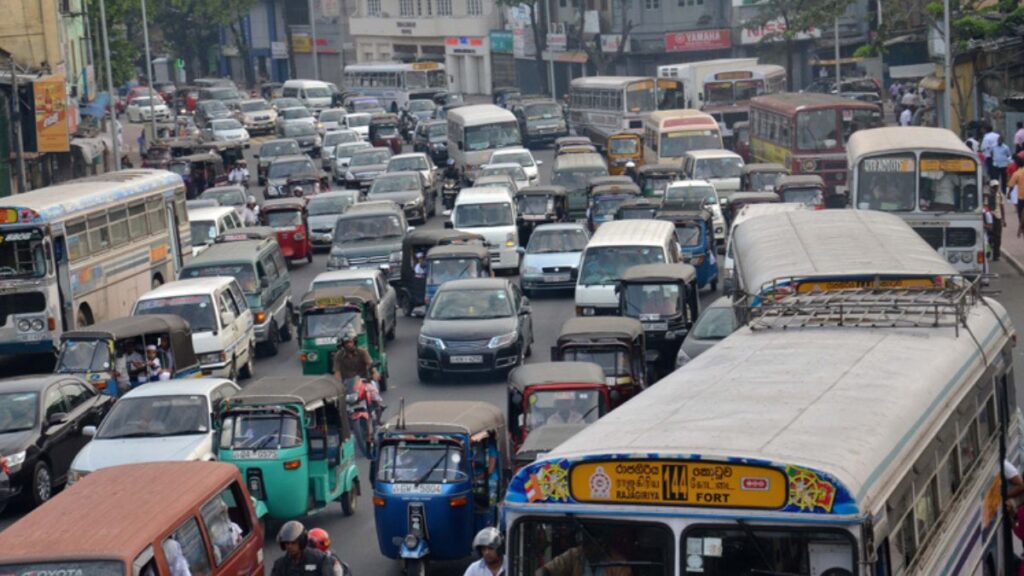
Sri Lanka’s latest attempt to tame Colombo’s worsening traffic congestion has raised a much larger question than how to redesign a few junctions: why is the country repeatedly spending millions of rupees fixing traffic problems created by fragmented transport planning in the first place?
Cabinet approval of an Rs.91.21 million feasibility study is the latest example of this reactive approach. The assignment, awarded to Master Hellie’s Engineering Consultants (Pvt) Ltd after evaluation of five shortlisted firms, includes Rs.52.44 million in local currency and US$122,859 in foreign currency, excluding VAT.
The consultancy has been tasked with finding solutions to severe congestion around Lotus Junction, the Port Access Elevated Highway off-ramps and the planned Marine Drive Link Road. Its mandate includes studying grade-separated connections, redesigning intersections, modifying turning movements and improving traffic signal coordination.
On paper, the exercise is technically justified. In practice, however, it exposes the consequences of a deeper policy failure.
The Port Access Elevated Highway was intended to accelerate movement between the port and the wider road network. But its termination has concentrated large volumes of traffic around Colombo Fort, D.R. Wijewardena Mawatha, Lotus Junction and the Port City approaches. Instead of eliminating congestion, infrastructure designed to improve mobility has effectively transferred pressure from one location to another.
The proposed solution is therefore another layer of engineering.
A bypass connecting the expressway off-ramps with the coastal road could divert southbound traffic towards Kollupitiya, Bambalapitiya and Wellawatte without forcing thousands of vehicles through Galle Road and the Lotus Roundabout. Ramp restructuring and improved signal sequencing could also reduce bottlenecks.
But the critical issue is what happens after this intervention.
If more expressway capacity simply encourages more private vehicles into central Colombo, today’s solution could become tomorrow’s congestion point. This is precisely the problem that Colombo’s earlier transport planning attempted to address through an integrated public transport strategy.
The JICA-backed CoMTrans Urban Transport Master Plan recognised that road construction alone could not resolve Colombo’s mobility crisis. It envisaged an interconnected system involving mass transit, improved suburban rail, bus-priority measures and Light Rail Transit.
Much of that vision was subsequently abandoned or delayed.
The most damaging reversal came in 2020 when the Colombo Light Rail Transit project was cancelled. The proposed 15.7-kilometre Fort-Malabe line, backed by a US$1.5 billion JICA loan arrangement, was intended to provide a high-capacity alternative to road transport. Its cancellation not only disrupted long-term transport planning but also resulted in reported financial consequences, including contractor-related claims exceeding Rs.5.8 billion.
Today, the state is effectively paying again to manage the consequences.
The irony is stark. Millions are now being spent studying how to move vehicles more efficiently around a junction when the fundamental problem is the overwhelming dependence on those vehicles.
Colombo does need immediate traffic engineering solutions. But a feasibility study costing Rs.91.21 million should also become a warning to policymakers: without a revived metropolitan mass-transit strategy, each new road project risks producing another junction requiring another expensive study.
The real cost of Colombo’s traffic crisis is therefore not merely measured in lost hours or fuel. It is measured in repeated public expenditure on remedies for a problem that comprehensive planning was supposed to prevent.