




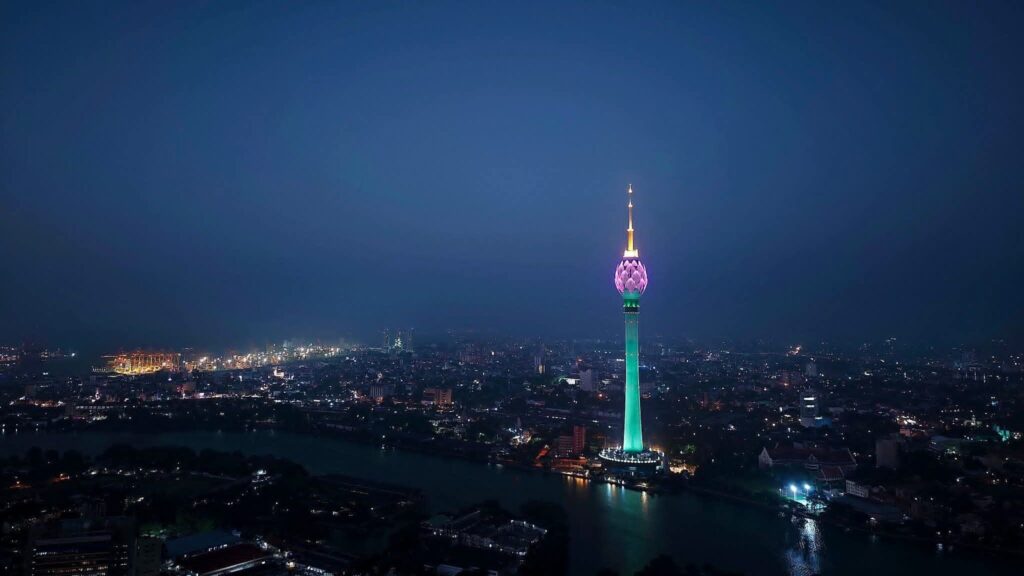
Rising 350 metres above Colombo, the Lotus Tower has undergone a remarkable transformation—from a controversial, debt-financed infrastructure project associated with financial irregularities into a commercially viable state asset generating substantial revenue.
However the turnaround does not erase the questions surrounding how the project was conceived, financed and implemented.
The $113 million tower was originally promoted as a major telecommunications facility that would strengthen Sri Lanka’s broadcasting and digital infrastructure. However, allegations of serious financial and procurement irregularities emerged almost from its inception.
One of the most controversial episodes involved a Rs. 2 billion advance payment authorised by the Telecommunications Regulatory Commission to Chinese co-contractor Aerospace Long-March International Trade Co. Ltd. Investigations subsequently raised questions after the company could reportedly not be located at its registered Beijing address.
The project also came under scrutiny from the Auditor General over the absence of a formal project proposal, independent feasibility assessment and transparent procurement process. Construction delays, land-related problems and extensions reportedly resulted in an estimated Rs. 5.4 billion in lost potential revenue.
More damagingly, the project’s financing structure exposed Sri Lanka to considerable foreign-exchange and debt-servicing obligations. Approximately 80% of the $113 million project cost was financed by China’s Exim Bank. Instead of relying on highly concessional development financing, Sri Lanka entered into commercial borrowing arrangements carrying significantly heavier repayment obligations.
The financial burden became particularly controversial because the tower was being constructed during a period when the country’s fiscal position was already deteriorating. The reported annual repayment obligation of around Rs. 2.4 billion highlighted the mismatch between debt servicing and the tower’s ability to generate immediate economic returns.
However, the financial story has changed considerably.
Under the Colombo Lotus Tower Management Company, the tower has increasingly shifted away from its original telecommunications ambitions and towards tourism, entertainment and commercial activities.
The figures demonstrate the scale of that transformation. During the first eight months of 2025, the tower generated Rs. 1.43 billion in revenue, a 31% increase compared with the corresponding period. Gross profit increased 77% to Rs. 786.86 million, while profit before tax surged 192% to Rs. 539.93 million.
New commercial initiatives including digital ticketing, a proposed Rs. 100 million Lotus Aquarium Café, luxury accommodation and extreme entertainment attractions—could further expand its income-generating capacity.
The crucial lesson, however, is not simply that the Lotus Tower eventually became profitable.
Its experience exposes the enormous difference between financial viability after construction and sound decision-making before construction.
A profitable asset cannot automatically justify questionable procurement, inadequate feasibility analysis or expensive borrowing.
The tower may now be capable of sustaining its own operations. But taxpayers remain entitled to ask how much the project ultimately cost, who benefited from the original financial arrangements, what accountability followed the alleged irregularities, and whether the state has learned the institutional lessons.
The Lotus Tower is therefore both an emerging commercial success and a continuing governance case study a reminder that profitability achieved years later cannot substitute for transparency at the beginning.