




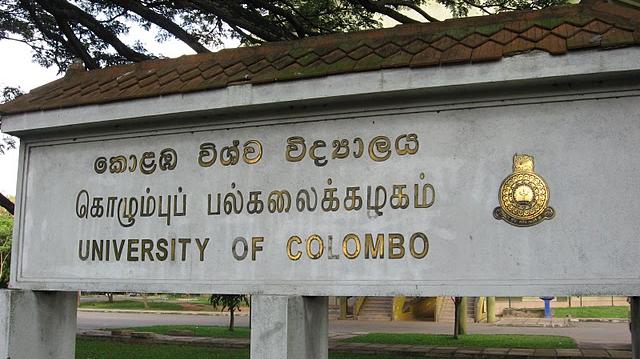
The extensive investigation launched by the Commission to Investigate Allegations of Bribery or Corruption (CIABOC) into the University of Colombo—widely regarded as Sri Lanka’s premier and most prestigious institution of higher education—has sent shockwaves through the entire state education system. These serious allegations, centered around a Higher Diploma in Management course, are not merely an isolated issue confined to one institution; they reflect a tragic mirror image of the crisis gripping the country’s entire state university framework today.
Grave Allegations Shattering Public Trust

According to a complaint lodged by a group of students, the alleged irregularities within this specific course at the University of Colombo are highly unethical and completely unacceptable for any educational institution.
- Selling Education for Money and Favoritism:
If the allegations regarding the leaking of exam papers prior to tests and upgrading grades in exchange for financial bribes are true, it represents a complete desecration of the sanctity of education. - Retaliation and Arbitrary Authority:
Failing students who refuse to comply with the inappropriate demands of certain lecturers, alongside the blatant violation of standard procedures, indicates that some academics believe they operate above the law.
Irresponsible Corporate Governance:
Falsifying results after failed students questioned their marks, and rushing to award degrees without investigating student complaints, highlights how corrupt or weak the institutional administration has become. This suspicion is further intensified by the lack of proper responses from the Vice-Chancellor or the Registrar when questioned by the media.
State Universities: Then vs. Now
Analyzing this incident critically, it is no secret—as observed through recent media reports and public discourse—that Sri Lanka’s state university system has suffered a severe decline. (However, it must be noted that such incidents have existed to varying degrees throughout the history of state universities, though perhaps not to this extreme magnitude).
Key Drivers of the Institutional Decline
Commercialization over Quality: Rather than focusing on internal degree programs, generating revenue through external degrees, diplomas, and postgraduate courses has become a primary objective. Operating without proper regulation, some lecturers have turned these paid programs into personal “money-making machines.”
- Lack of Academic Accountability: University academics traditionally command the highest respect in society. However, recent media reports have frequently highlighted instances of malpractice, demands for sexual bribes, and political bias. Some individuals use the guise of “academic autonomy” to operate with absolute impunity.
- Brain Drain & Resource Scarcity: Driven by the ongoing economic crisis, a vast number of talented and honest lecturers have left the country. This has placed an immense burden on the remaining minority, allowing a few corrupt individuals to take control of the system and act arbitrarily.
The Way Forward
The ultimate victims of such large-scale examination scams are the innocent students who sacrifice their sleep and well-being to study with dedication. Furthermore, when such news reaches the international arena, the global recognition and validity of degrees and diplomas issued by Sri Lankan state universities are put at severe risk.
The investigation initiated by the Bribery Commission is highly timely. It must be brought to a transparent conclusion without any political or institutional interference. The University Grants Commission (UGC) and the Ministry of Education must not treat this as an isolated incident restricted to a single university. Instead, they must conduct a rigorous, comprehensive audit of exam administration and quality assurance across the entire university network.
An education system built on fraudulent grades and bribery can never produce ethical or productive professionals. This alarming wake-up call from the University of Colombo might just be the final opportunity to clean up and restore the integrity of the entire state education system.