




By a special correspondent
Lord Marland’s two-day visit to Sri Lanka may appear ceremonial on the surface, but viewed through a political economy lens, it reveals the quiet recalibration now underway between a left-leaning Government and global capital networks.
As Chairman of the Commonwealth Enterprise and Investment Council, Lord Marland sits at the intersection of diplomacy and commerce. CWEIC is not a think tank or aid agency; it is the Commonwealth’s official vehicle for mobilising private investment. Its engagements typically follow moments of crisis, regime change, or reform when countries are most open to restructuring their economic frameworks.
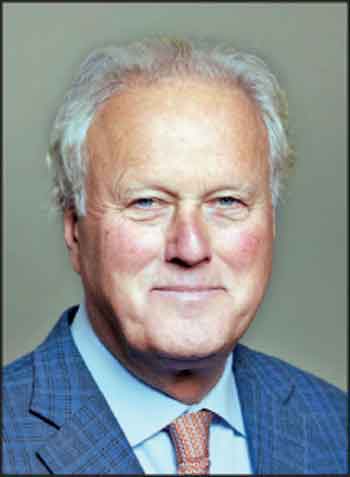
CWEIC Chairman Lord Marland
Sri Lanka fits that profile precisely. The NPP Government, led by President Anura Kumara Dissanayake, swept to power on an anti-establishment platform rooted in Marxist political tradition. Yet, inheriting an economy still under IMF surveillance, the administration has little room to ignore external actors who influence investment sentiment.
Lord Marland’s visit his first since the establishment of a CWEIC hub in Sri Lanka suggests a strategic intent to anchor the country firmly within the Commonwealth’s trade and investment ecosystem before policy uncertainty sets in. Meetings with the President and leading private-sector stakeholders are expected to focus on “economic recovery,” but the subtext is investor confidence: regulatory predictability, openness to public-private partnerships, and continuity with global market norms.
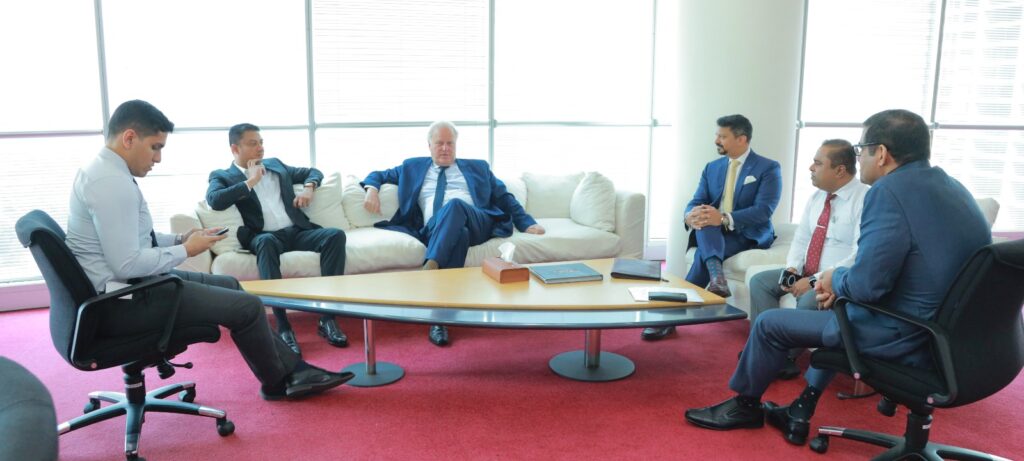
For the NPP leadership, the optics are delicate. Engaging a British peer associated with conservative economic ideology risks criticism from core supporters who expect a break from externally driven economic models. Yet refusing such engagement could spook investors already wary after years of instability.
Observers note that CWEIC’s approach is typically incremental rather than ideological. It does not dictate policy but works to align domestic priorities with international capital interests. In that sense, Lord Marland’s mission may be less about immediate deals and more about mapping where the NPP Government stands on issues such as foreign ownership, State enterprise reform, and long-term trade integration.
The visit also highlights the Commonwealth’s evolving role. No longer merely a historical or diplomatic forum, it is positioning itself as a parallel economic bloc particularly attractive to middle-income countries seeking diversification beyond traditional Western lenders.
Whether Sri Lanka can leverage this engagement on its own terms remains an open question. Much will depend on whether the NPP Government can translate political legitimacy into a coherent economic strategy that reassures investors without alienating its social base.
Lord Marland’s Colombo meetings may not produce headline-grabbing announcements, but they mark an early signal: Sri Lanka’s new political order is already negotiating its place within old global systems carefully, cautiously, and under intense scrutiny.